ALX Surveillance
The state of surveillance in Alexandria
Flock is the surveillance company city residents increasingly recognize — both from press and from their automatic license plate reader (ALPR) cameras posted on poles around the city. Flock is also just one company Alexandria’s police are using across at least eight categories of surveillance technology. It’s possible other departments across the city are using even more surveillance tech, but we don’t know about it. No company, contract, or tech has ever gone before a public vote.
Because of the lack of government transparency, information on this page has been pieced together by city residents from a variety of sources: a map built by volunteers around the country, filings the Commonwealth requires, policies the police department wrote for itself, and records somebody had to go and request.
It is incomplete. Finding out what your own city operates should not take this much digging.
Why we start with Flock ALPR cameras
Flock ALPR cameras are not the only surveillance technology the city of Alexandria uses. The city also runs cell site simulators, drones, GPS trackers, and more, from a variety of vendors. All of it deserves the same public disclosure process.
Flock cameras come first on this page because residents can actually see and document them. ALPR cameras bolted to a pole are visible from the sidewalk, while a cell site simulator or a software license is not. Flock ALPR cameras are also the one system the city of Alexandria has been forced to disclose the most about, in part as a reaction to mounting concerns with the vendor. Flock certainly should not still have the keys to our city’s sensitive data. But, let’s be clear, we also don’t want another manufacturer of ALPRs to quietly replace Flock without meaningful public input — a strategy used by police departments and city councils across the country.
For more on what Flock is and the concerns around how it’s used, see our FAQs.
Where the cameras are
This is DeFlock’s crowd-sourced map, opened on Alexandria. Volunteers built it by walking around and noting what is visible from the sidewalk. Zoom in and find your own street.
Source: deflock.org, where you can also add a camera they have missed.
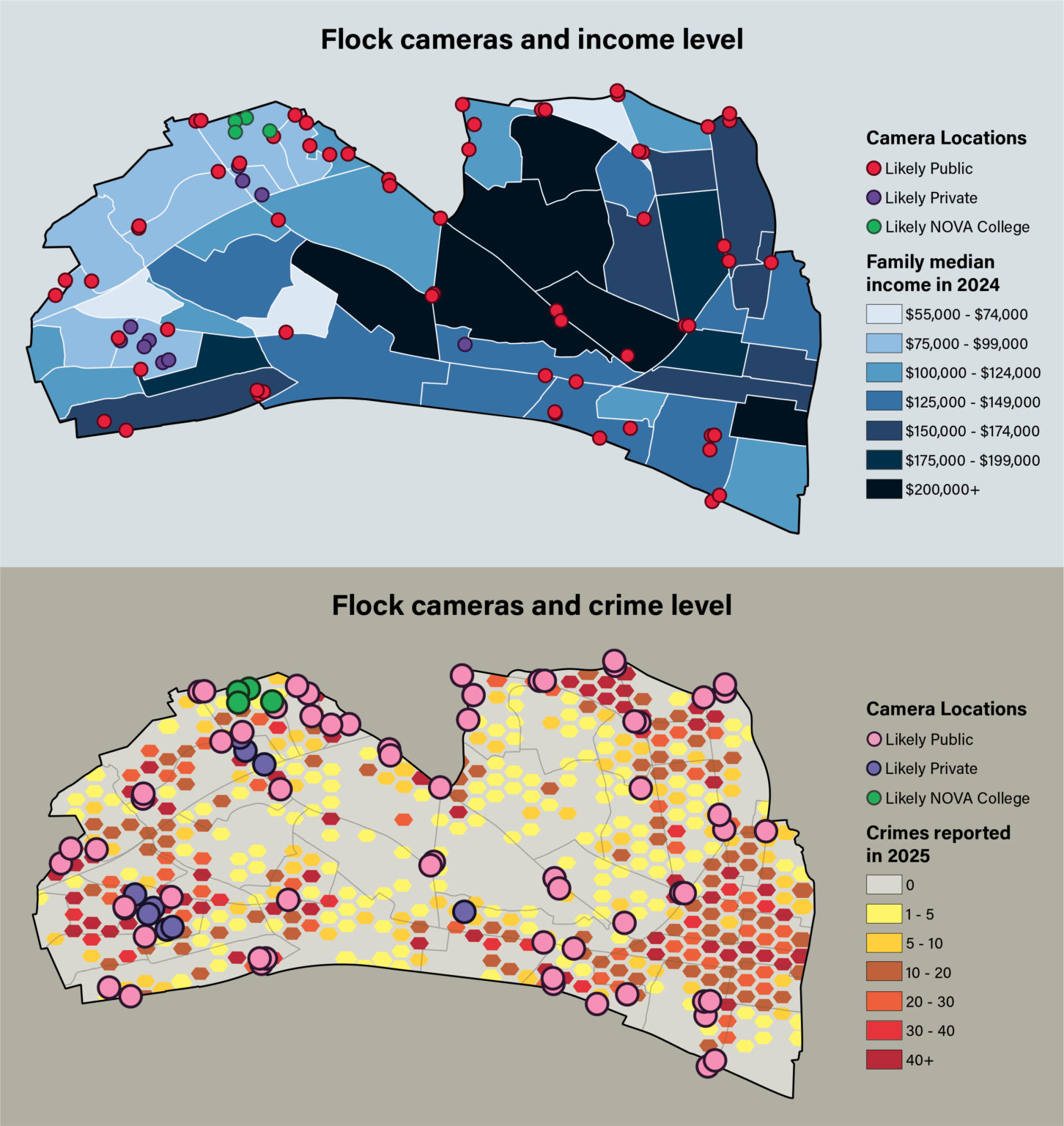
The Alexandria Times found that Flock cameras were disproportionately concentrated in lower-income neighborhoods (and echoed patterns of heavier deployment in predominantly Black, high-poverty areas elsewhere) but largely absent from high-crime areas like Old Town and Potomac Yard. Such placement raises concerns that the camera locations reflect surveillance bias rather than crime-driven need.
It’s not just Flock
Virginia law requires every police department to report annually to the state which surveillance technologies it used, accessed, or procured. Alexandria’s filing for July 1, 2024 – June 30, 2025 reports 8 categories in use. None of them has been the subject of a Council hearing. We had to request this filing to read it; the city has never volunteered it.
Filed with the Virginia Department of Criminal Justice Services under Va. Code § 9.1-116.10 by Sergeant Oliver Dunn. Category names below are quoted exactly as they appear on the state’s form.
International mobile subscriber identity (IMSI) catchers and other cell site simulators
Devices that impersonate a cell tower so nearby phones connect to them. Alexandria has never discussed this publicly.
Automatic license plate readers (like Flock)
Closed-circuit television cameras
Video and audio monitoring or recording technology, such as Body-Worn Cameras, other surveillance cameras, and wide-angle cameras
Tools, including software and hardware, used to gain access to a computer, computer service, or computer network
Software designed to integrate or analyze data from surveillance technology, including surveillance target tracking and predictive policing software
A broad category. Checking it tells us the department uses surveillance-analysis software; it does not tell us which products, and it is not by itself evidence of predictive policing.
Drones
GPS Trackers
Show the categories the department marked as not applicable
- Electronic toll readers
- Facial recognition technologies
- Other biometric surveillance technologies, including voice, iris, and gait-recognition software and databases
- Mobile DNA capture technology
- Gunshot detection and location hardware and servicesWorth stating plainly: the department reports it has none. Alexandria does not operate gunshot detection.
- X-ray vans
- Surveillance enabled or capable lightbulbs or light fixtures
- Social media monitoring software
- Through-the-wall radar or similar imaging technology
- Passive scanners of radio networks
- Long-range Bluetooth and other wireless-scanning devices
- Radio-frequency I.D. (RFID) scanners
- Any third party service or third party subscription that allows access to any form of surveillance technology or the data therefrom
The filing also reports assistance received from NVERS — Northern Virginia Emergency Response System (training on counter surveillance systems, Dedrone, etc.)
None of this has had a public hearing
A search of the city’s legislative records turns up no docket item, in any year, for Flock, license plate readers, or automated license plate recognition. The purchases and every renewal since have been handled administratively, by the Purchasing Division.
Based on FOIA, we believe the most recent renewal was signed in April of 2026 — but we still don’t have a clear answer as to exactly what contracts we have signed, under what terms, and when they end.
What we still don’t know
Every one of these questions could be answered in a public hearing.
- When was Flock's contract signed, when does it end, and what are the conditions for termination?
- What is the justification for 21-day ALPR retention defaults that makes Alexandria differently situated from other communities with shorter retention?
- Which of the 161 agencies with access have searched Alexandria police Flock ALPR data, and what were they looking for?
- Before the 2025 Virginia ALPR statute took effect, was our Flock ALPR data shared with out-of-state agencies or the federal government?
- How would police audits of Flock ALPR data regulate external use, if at all? How does Alexandria police authenticate stated ALPR use category? What is the most common ALPR use category used by Alexandria police?
- Is there strong evidence ALPR technology reduces crime and, if so, what types of crime?
- What is Alexandria Police Department using other listed surveillance technologies for? Under what circumstances? What oversight applies?